Evil?
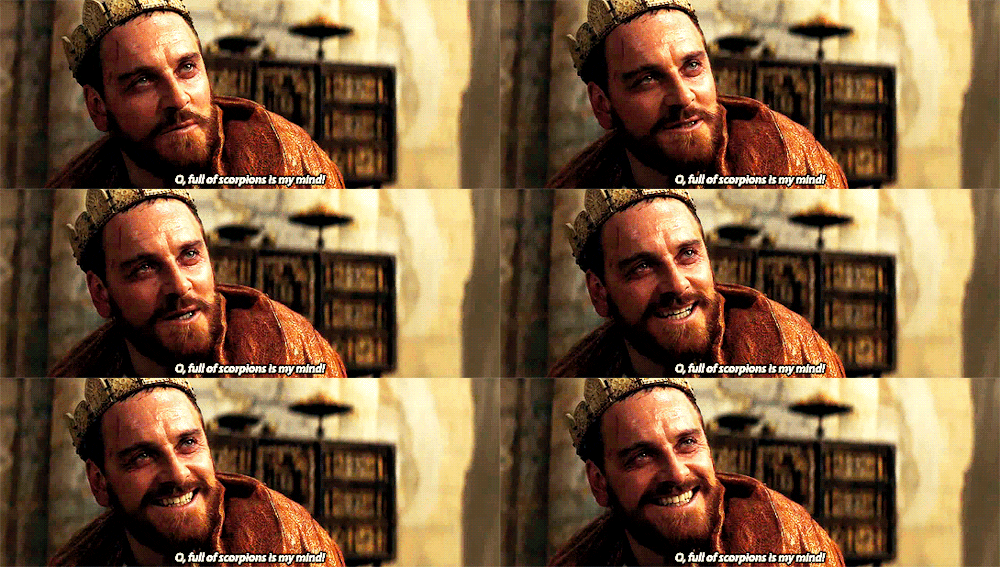
I believe control in life is a very powerful force. The moment when control over your life translates into power over others is when this notion may become dangerous. Power, as we have observed in the case of Macbeth, is intoxicating. Dictators and oligarchs have succumbed to it time and time again, yet humanity still falls victim to the disease. It could be argued that Macbeth was enticed by the concept of a kingdom. It could also be said that he was simply mentally ill. Both of these factors could be reasons for his sudden need for absolute power through evil. His good nature changed suddenly because of that walk "down the primrose path to the everlasting bonfire" that the witches seemingly took him on.
Was this evil Macbeth's fault? Or was the evil that suddenly raged inside of him a product of the mental illness that could be perceived in the text? I think that mental illness can greatly impact evil action if not cause it. This situation in Macbeth had stunning parallels to a podcast I listened to a little bit ago. It was about a respected doctor who was a friend to all of his patients. Oh and, by the way, he strangled his own father and is now in jail. This was a man who had previously only done good works in his life. After years of telling people that he was not mentally right at the time of the crime or in the present, the doctor who took his job looked into the issue. That's crazy, right? After some testing, it was discovered that he has Huntington's disease—a lethal combination of Parkinson's, Alzheimer's, and ALS. This is what had been causing his mental fog, and the reason he killed his own father. I am not saying that Macbeth has Huntington's disease, but sudden behavioral changes and evil inclinations do point to some type of psychological issue. One instance from the text that supports this theory is when Macbeth is hallucinating and sees a dagger in the air. He says, "A dagger of the mind, a false creation proceeding from the heat-oppressed brain?". This quote certainly points to a lack of mental clarity. This psychological turmoil may just have been a consequence of the guilt Macbeth had following the murders he committed. This is an internal consequence that Macbeth and Lady Macbeth had to endure. An example of Lady Macbeth's departure from sanity is when she sleepwalks and tries to wash her hands of the blood she has spilled. Guilt can drive you mad just as quickly as madness can make you evil.
In conclusion, many things can drive a person to become evil in nature. For Macbeth, I believe that it was his own mind that eventually led him astray. Ironically, it was his mind that was ripped from his body in the end so maybe in the next life he was a peace from his sporadic thoughts. Desire and ambition are motivators but desire and ambition stem from mental corruption.
Works Cited
Collins, Anne, and William Shakespeare. Macbeth. Pearson Education, 2016.
“Dr. Gilmer and Mr. Hyde.” This American Life, 4 Dec. 2018, www.thisamericanlife.org/492/dr-gilmer-and-mr-hyde.
GIPHY. “Michael Fassbender Macbeth GIF - Find & Share on GIPHY.” GIPHY, GIPHY, 5 Apr. 2018, giphy.com/gifs/william-shakespeare-macbeth-filmkritik-4svyOuwbLEaqY.
“Huntington's Disease.” Alzheimer's Association, Alzheimer's Association, www.alz.org/alzheimers-dementia/what-is-dementia/types-of-dementia/huntington-s-disease.

Interesting ideas here!
ReplyDelete